Joaquim Gromicho
See profileAnalytics for a Better World
See profileUnleashing the (Super)Power of Analytics for a Better World
A retrospective on Professor's Joaquim Gromicho Inaugural Lecture as ORTEC Chair of "Analytics for a Better World"

A retrospective on Professor’s Joaquim Gromicho Inaugural Lecture as ORTEC Chair of “Analytics for a Better World” – Joaquim Gromicho | Analytics for a Better World | What if our world could become a better place, not because of superheroes who have suprahuman powers, but because of dedicated mathematicians who co-create solutions for optimization problems […]
What if our world could become a better place, not because of superheroes who have suprahuman powers, but because of dedicated mathematicians who co-create solutions for optimization problems with the non-profit and humanitarian sectors?
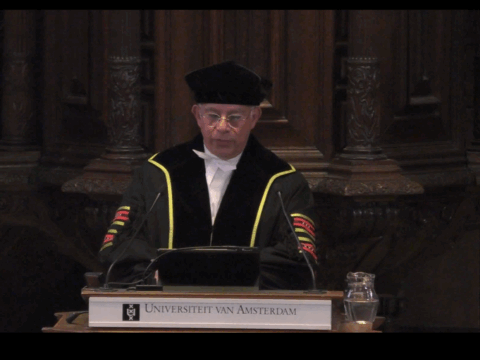
This is the question that opened the inaugural lecture of Professor Joaquim Gromicho, now the ORTEC Chair for “Analytics for a Better World” at the Faculty of Economics and Business of the University of Amsterdam. Professor Gromicho, a mathematician at heart, has spent nearly thirty years blending theory and practice. From early studies in Portugal—long before machine learning became fashionable—to a career spanning industry, academia, and optimization involvement in global humanitarian work through the synergy between industry and academia, his lecture attests to how analytics can change outcomes for millions when applied with an ethics of care for the communities we serve.
From Industry to Academia—and Back Again
The red thread in Professor Gromicho’s career is his long engagement with ORTEC alongside academic appointments at the University of Amsterdam and at the Vrije Universiteit. Rather than treating industry and academia as separate worlds, he described building a “bridge” between the two, resulting in unique collaborations and co-created solutions.
This is reflected clearly in the PhD work he supervised. One of the earliest examples is the doctoral research of Jelke van Hoorn, working on the industry side at ORTEC, who, 19 years later, is one of ORTEC’s Experts in Operations Research. Jelke’s thesis tackled dynamic programming for routing and scheduling—problems known for their computational difficulty. His work produced algorithms that guaranteed optimality without relying on mixed-integer linear programming and even enumerated many distinct optimal solutions for benchmark instances. His work proved that rigorous theory and industrial relevance are not opposites but can be the result of meaningful partnerships.
Professor Gromicho’s mentorship was more than technical. The two shared the dedication to applying rigorous theory and industry insights for a better world. Now, Jelke van Hoorn is involved with Analytics for a Better World as an ORTEC Expert in Operations in co-creating solutions in the non-profit sector on projects with Médecins Sans Frontières, and with Fleet Forum for the Impact Accelerator Program.
Why the World Needs These Skills Now
Professor Gromicho stated the unjust facts of the world we share: nearly half the world’s population lacks timely access to basic healthcare; hundreds of millions face hunger; and political decisions made far from the field can translate into millions of preventable deaths. These are not abstract problems; they are logistical, spatial, and optimization problems at scale.
Here, analytics stops being an academic exercise and becomes a tool for serving vulnerabilized communities to uphold fundamental human rights.
Through the work of the Analytics for a Better World Institute, the ABW network and he apply optimization to challenges that rarely appear in textbooks. Predictive models and dynamic programming guide ocean-plastic-cleaning systems across vast stretches of the Pacific in collaboration with experts from the Ocean CleanUp and the London Business School. Large-scale location models explore where new stroke centers in Vietnam would save the most lives. During the COVID-19 pandemic, accessibility analyses in Nepal revealed that simple administrative policies, not geography, were preventing people from reaching PCR labs, and that more thoughtful facility placement could dramatically improve coverage without additional infrastructure.
Several of these projects are co-driven by doctoral and master’s research. One master’s student developed scalable heuristics that outperformed exact optimization models simply by allowing candidate locations at finer spatial resolutions. Another PhD project in progress explores how to incorporate demand estimation with routing optimisation into optimization models for mobile vaccination clinics in Kenya. Yet another focuses on locating water wells in Sudan by learning where water is likely to be found, not just where it is convenient to dig.
I did inaugurate my first chair in applied mathematics in 2011. By then, the term “applied” was sometimes received with some scepticism—it was seen as serving industry and perhaps having less value than more theoretical chairs. But I was already convinced that there is no way one can have impact, even in industry or in society in general, without sound theory.
Teaching the Next Generation of Change-Makers
Education is not an afterthought in Professor Gromicho’s lecture; it is the driving force. At the University of Amsterdam, he teaches courses with names that bring his ambition for education to the core: Analytics for a Better World and Advanced Analytics for a Better World. From the first lecture, students are told that analytics is not only about efficiency or profit, but also about responsibility towards the world we share.
Remarkably, these courses remain full from start to finish. Students trained in prescriptive analytics and mathematical optimization respond strongly to the idea that their skills can help address hunger, health, inequality, and environmental damage. Professor Gromicho attests that the next generation of OR researchers, data analysts, and AI experts he teaches with Professor Dick den Hertog and PhD candidates Britt van Veggel and Trang Luu is driven by a dedication to contributing to a better world rather than profit.
Open Tools, Collective Impact
Another running thread in his lecture was openness. Many of the tools developed through these projects are released as open source, supported by shared code repositories and collaborative platforms. This openness allows humanitarian organizations—such as the World Food Programme—to scale up their analytical capabilities. He emphasized how optimization models in food logistics have already helped save millions more lives with the same budget, an achievement recognized with the Franz Edelman Award in the case of the World Food Programme.
A Mindful Reflection
Professor Gromicho ended his lecture not with theoretical insights, but with human insights of gratitude to mentors, colleagues, students, industry partners, family, and organizations that made this journey and all these achievements possible. He also highlighted a moral reminder: talent and knowledge are not possessions but responsibilities we ought to use together to create a better world for all of us.