ORTEC
See profileUniversity of Amsterdam Business School
See profileThe Impact-First ABW Flagship Program Begins
Meet the five non-profit organizations joining the inaugural Impact Accelerator Program cohort
Meet the five non-profit organizations joining the inaugural Impact Accelerator Program cohort – ORTEC | University of Amsterdam Business School | Some of the most important work directly impacting underserved communities is being done by non-profit organizations that have rich on-the-ground knowledge, but who are also in the early stages of their data maturity journeys. […]
Some of the most important work directly impacting underserved communities is being done by non-profit organizations that have rich on-the-ground knowledge, but who are also in the early stages of their data maturity journeys. In 2026, Analytics for a Better World took a step toward accelerating the impact non-profit organizations can have. Five non-profit organizations joined the inaugural cohort of the Impact Accelerator Program, each bringing a purposeful, complex challenge, and each beginning a co-creation journey with world-leading data and AI-experts to build sustainable and scalable solutions that enhance the impact achieved through their already existing robust, on-the-ground, localized knowledge.
This is not a program about technology as an end goal, but a program that focuses on how to better serve marginalized communities in low- and middle-income contexts by unlocking the power of ethical data science and AI. ORTEC’s EVP, Frans van Helden, couldn’t have said it better during the launch: focus on the goals first, and the right technological solution can surely be co-created. This human-centric technology principle sits at the heart of what makes our Impact Accelerator Program valuable.
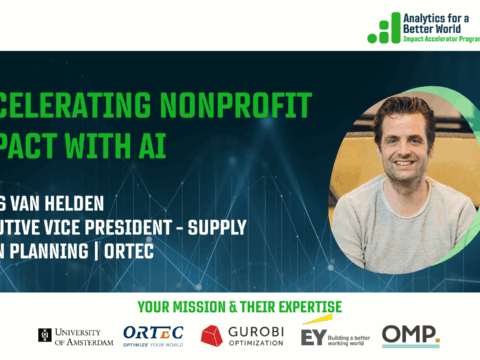
Frans van Helden, the EVP Supply Chain Planning, opened the launch of the Impact Accelerator Program with a big shout-out to the five selected non-profit organisations. Having been at ORTEC — ABW’s co-founding partner — for over 15 years, van Helden wanted to highlight that well-managed, financially successful companies that have achieved great results through data analytics and AI have had to endure the tedious work involved in dealing with data. “Data can always be better,” he said. Many significant actors in the private sector still use Excel worksheets, even though more advanced software applications are available. Sometimes the advanced software is there, but the human capacity is not. However, success is not determined solely by the best technology solutions, but by a well-managed innovation process focused on the purpose of the innovation rather than on the technological means alone. And this is what the Impact Accelerator Program offers: a well-managed co-creation process that clearly sharpens focus, enabling strong commitment to achieving the purposes of the submitted challenges. van Helden’s advice for success?
Focus on the goals of your projects first, and you will be able to realise a successful technological solution. The cohort should rest assured that they are on a path to success, as it is clearly driven by purpose first.
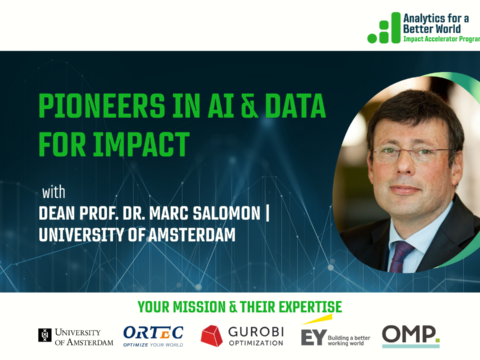
The Dean of the University of Amsterdam Economics and Business Faculty, Roel Beetsma, also joined in celebrating the five participating teams and expressed confidence in their fast progress through the program regarding their data maturity journeys. As a co-founder of ABW, he expressed that this flagship program represents a significant milestone for the University of Amsterdam in bridging academia, private organisations, and the NGO sector to advance the SDGs. In challenging global times — particularly in low- and middle-income countries — complex societal problems require powerful partnerships. While NGOs possess invaluable expertise and community connections, combining these with academic research, AI capabilities, and private-sector resources creates a formidable coalition for change. The current accelerator cohort’s diversity — humanitarian fleets’ sustainability, education, water access, healthcare, and preservation of historical information heritage — highlights the broad applicability of analytics. Beyond building NGO capacity, the program facilitates cross-organisational learning that benefits all partners. The dean closed with gratitude to all supporters, especially co- founding partner ORTEC, whose involvement has been indispensable to the program’s existence.
The program launch key speakers also reflected the spirit of the program, namely, to bring non-profit organizations, industry, and academia together for co-creating solutions that can bring and sustain systemic change. War Child Alliance — with which ABW partnered for a project in 2025 — also shared their story on how impactful data can be in accelerating impact. Operating across 15 countries, they have a distinctive approach that centres on evidence-based methods developed by an in-house research and development unit, focusing on child protection, mental health and psychosocial support, and education. Their challenge was translating rigorous research findings into real-world implementation at scale across diverse contexts. They needed to ensure that evidence-based methods that achieve positive outcomes in research settings would deliver the same impact when implemented by various partners globally, without the same controlled conditions or data-collection capabilities.
War Child identified three critical indicators to track quality: attendance, facilitator competency, and fidelity of implementation. By measuring these indicators, they could verify both the quality of implementation and the achievement of outcomes. The problem was tracking these indicators across multiple partners in different locations while providing real-time data access for quick decision-making. Their partnership with Analytics for a Better World, beginning in 2023, involved scoping workshops to understand the problem, define use cases, and assess IT capabilities. Through weekly sprint meetings in early 2024, the team developed a proof-of-concept dashboard visualizing attendance, fidelity, and competency data, along with a report outlining development pathways. War Child has since continued iterating with their internal data team and incorporated data quality as a key focus.
The key lessons shared? Starting with the real problem, managing expectations around time and resources, planning for long-term staffing and maintenance costs, ensuring partner ownership and engagement, and securing senior management buy-in — all components included in the design of the Impact Accelerator Program.
It is this first-hand knowledge of what works, what takes time, and what must never be overlooked that now shapes the experience of the five organisations in the inaugural cohort. Here is what brought each of them here.
Working on SDG 4 — Quality Education — Teach the World Foundation identified a critical challenge in education delivery systems: the lack of a unified, objective method for measuring and managing school quality. Current indicators are isolated, incomplete, and often anecdotal, failing to comprehensively assess either implementation fidelity or achieved results. This fragmentation prevents program teams, local and international organisations, and, especially, governments from systematically identifying the specific support that individual schools need to improve quality.
The proposed solution integrates disparate data by creating a composite School Quality Index combining indicators from enrollment, attendance, quality monitoring, app analytics, learning assessments, and community feedback. This composite index is visualised through a dashboard that maps schools as healthy, vulnerable, or critical, and issues automated alerts to relevant stakeholders when quality drops, identifying which specific indicator is causing the decline. This targeted approach enables implementers to take precise action, identifying the right school and the right interventions needed to sustain or improve the quality of learning delivery.
Through the Impact Accelerator program, Teach the World aims to build and test the School Quality Index, then institutionalise it across Sindth in partnership with the government, with plans to scale the solution across 40,000+ schools.

AMREF’s work advances progress on SDG 6 — Clean Water and Sanitation. Their challenge is to make borehole drilling more successful in ASAL regions, where testing these areas to locate viable boreholes is expensive, and success rates are low. The current situation relies on expensive expert assessments or surveys that often fail, and available data is fragmented, creating challenges around data categorization and quality improvement. The organization aims to use spatial data and machine learning to develop a tool that increases drilling success, which matters because finding cheaper, more effective methods would rapidly increase health benefits for local communities while lowering program costs and freeing funds for other initiatives.
The solution will unfold in three phases: model development uses AMREF-provided data to identify uncertainty ranges for potential borehole locations, validated against historical data; prototyping translates the model into an accessible interface with iterative testing to identify strengths, weaknesses, and improvements; and post-program product refinement and implementation deploys the prototype in actual field use, measuring real-world improvements. The project’s ambitions include delivering a working prototype that scores locations with higher confidence and success rates than the current methodology, plus comprehensive documentation to transfer knowledge to AMREF, with the machine learning approach offering scalability across different data architectures and regions.
Advancing SDG 13 — Climate Action — in an innovative manner, Fleet Forum, together with ORTEC, is piloting an Interagency Mobility Plan in Lebanon to accelerate the humanitarian sector’s shift from car-centric transportation to sustainable mobility planning. The challenge is that the humanitarian sector relies heavily on car-centric models for daily operations, with virtually no consideration of alternative modes such as walking, cycling, or public or informal transport. Staff commuting between home and office is rarely factored into organisations’ mobility burden, and there’s insufficient cooperation and coordination around mobility issues.
While data on organisational mobility demand exists, it’s underutilised for informing sustainable, evidence-based decisions about optimal transportation modes beyond defaulting to cars. The solution begins by establishing a mobility dashboard that captures a baseline snapshot of participating organisations’ transport demand, assesses transport costs, and overlays available alternative transport modes on routes currently travelled by car. This feeds into a mobility advisor that evaluates the potential impact of shifting from car-centric models to selected alternative transport modes, allowing organisations to prioritise the most impactful actions for reducing mobility costs and footprints. These insights directly inform mobility plans aimed at modifying internal processes, procedures, or policies currently preventing movement away from car dependency, with the standardised dashboard and tools supporting replicability across countries and areas where humanitarian action occurs.

The InfoNTD Consortium, made up of No Leprosy Remains and Sightsavers, along with OMP, is working on SDG 3 — Good Health and Well-being — by developing a chatbot solution for the InfoNTD digital knowledge platform that provides users with current, accurate information, resources, materials, news, and events on neglected tropical diseases. Currently, users face difficulties obtaining instant, summarised, personalised, specific, and translated results.
This challenge matters because health workers need practical information quickly. Scientific publications often exceed 30 pages, but they lack the time to review extensive material and require concise formats that deliver essential information to inform their ground-level work. The project targets low- and middle-income countries, focusing on developing a minimum viable product chatbot for frontline health workers to address cross-cutting issues in NTDs.
Following the proof of concept, an MVP chatbot will be co-created in an agile manner, with close collaboration and continuous feedback from the InfoNTD team, and pilot testing to capture feedback for potential MVP iterations before public deployment.
The desired outcome is that health workers in low- and middle-income countries can access information on NTD cross-cutting issues through a chatbot that provides instant quality responses, personalised and summarised content, and translations into French, Spanish, and Portuguese, initially, with user questions providing deeper insights into the resources needed and accessed on the platform.
Advancing progress on SDG 16 — Peace, Justice and Strong Institutions — Archivi.ng is tackling one of Nigeria’s most quietly urgent crises: the fragmentation and disappearance of its historical memory. Pre-colonial, colonial, and pre-1960s Nigerian history is scattered across multiple locations and formats, with much of it only accessible through foreign institutions such as the Library of Congress or the British Library. Nigeria’s National Archives exist in just four zones, requiring extensive travel for basic research access —and for materials that have survived this long, time is running out. Climate deterioration is physically destroying what remains. Newspapers turn to dust when touched. Some materials are already too fragile to handle. Historical illiteracy, as Archivi.ng knows well, has real consequences.
Their response works across three interconnected activities — digitisation, accessibility, and sense-making — turning fragile materials into structured, searchable knowledge available online. Underpinning this is a data governance framework that defines ownership, metadata standards, and validation checkpoints across the full archival lifecycle, replacing informal practices with a documented, scalable system that reduces data loss and gives the team end-to-end visibility over their work.
Currently focused on Nigeria, Archivi.ng’s ambition extends across West Africa and ultimately to anyone, anywhere, who wants to understand this history.