Theory of Change
Introduction
Analytics for a Better World (ABW) is a non-profit organization founded in 2022 by the University of Amsterdam and ORTEC. We collaborate with mission-driven organizations worldwide to use cutting-edge analytics and data science to maximize their impact.
We bridge a crucial gap: while analytics and AI have revolutionized business, their transformative potential for social good remains largely untapped in the nonprofit sector. Our vision is to unlock the potential of analytics for people who make the world a better place.
Our 2025-2028 Strategy represents a bold shift from isolated successes to scalable, systemic impact. Through focused initiatives, strategic partnerships, and open knowledge sharing, we aim to unlock the potential of thousands of nonprofits and accelerate progress toward the Sustainable Development Goals.
Our Theory of Change serves as both compass and learning tool—ensuring our efforts are purposeful, coherent, and aligned with our vision of data science for social good.
1. We use the terms mission-driven organizations, NGOs, and nonprofits interchangeably to refer to organizations whose primary purpose is to create positive impact rather than generate profit. Our focus on working with these organizations stems from our commitment to using analytics and AI to drive meaningful change and contribute to the greater good.
2. We define impact as the measurable change or effect that an action or initiative has on a particular group, community, or environment. It’s the tangible outcome that results from an intervention, often aimed at addressing a specific need or challenge.
The ABW Theory of Change
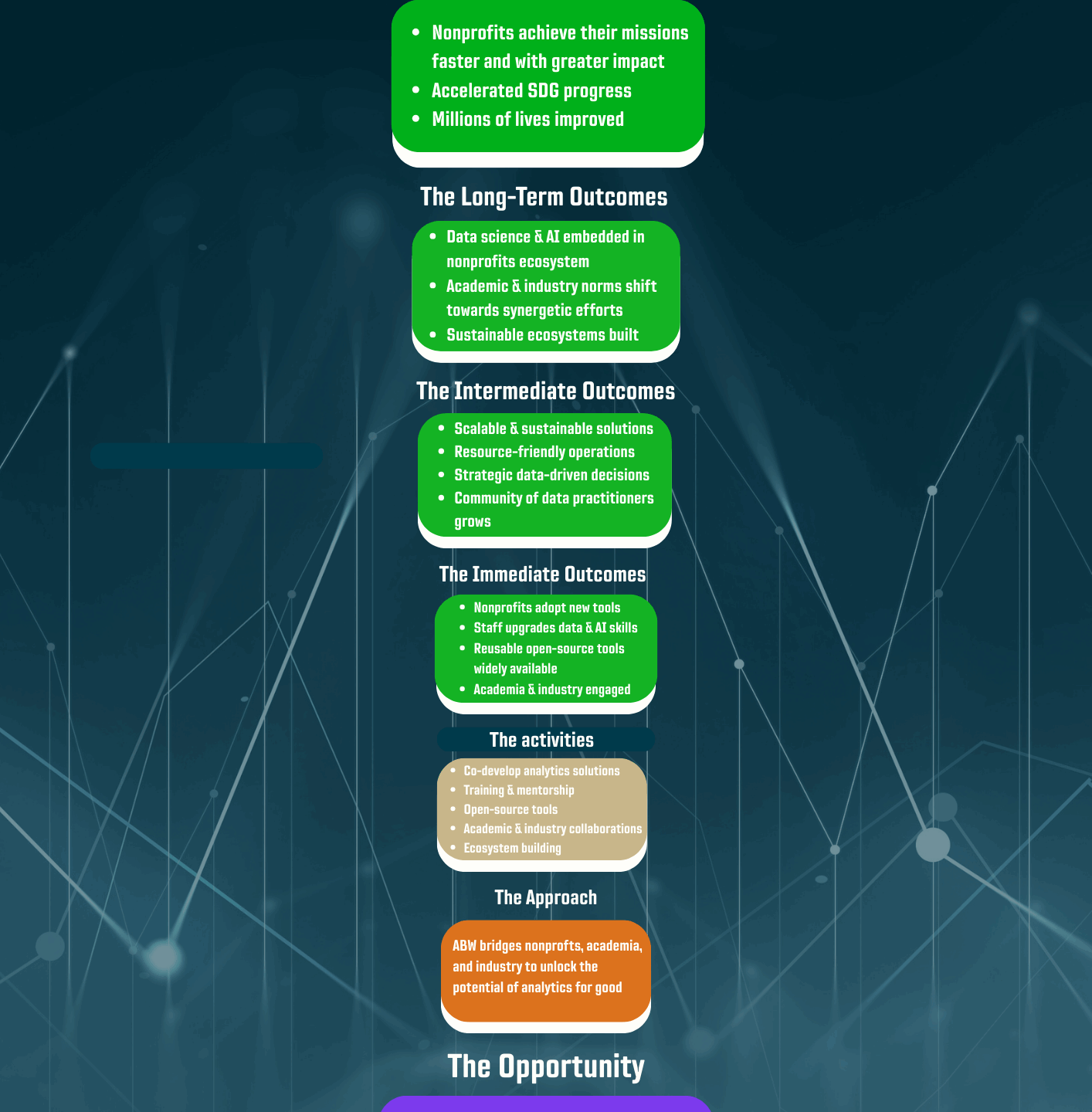
What problem do we want to address?
With decades of effort, only 17% of the Sustainable Development Goals (SDGs) are on track, with just five years left to achieve them. The scale of the challenge is huge: 3.16 billion people cannot reach a healthcare facility within an hour’s walk, over 4.4 billion people in low-income countries lack access to safe drinking water, and climate change has inflicted $525 billion in losses on the world’s most vulnerable economies in just two decades. Meanwhile, the economic cost of plastic pollution reaches up to $19 billion each year.
At the same time, the context for mission-driven organizations is tough. Funding is under increasing pressure, with major donors like USAID and the EU reducing their support. This means nonprofits should do more with less, whilst the complexity and urgency of global challenges grow. Simultaneously the speed of AI developments is increasing. Still, many nonprofits have yet to develop their data maturity. Or a framing that emphasizes that there are strengths that will only be scaled through (3.5M data for social impact jobs are needed), tools, and capabilities to harness these technologies. We think traditional approaches are no longer enough. We see much potential and opportunities for the nonprofit sector to start utilizing analytics in response to these challenges.
Analytics and data science offer a path forward: organizations that prioritize data-driven innovation are four times more likely to achieve their goals, and every dollar invested in data systems can yield a thirtyfold return in social value (an ROI of US$32). The opportunity is clear: we cannot afford to leave the power of analytics untapped. If we fail to act now, we miss a big opportunity to help millions more people in need, and the world will miss its chance to achieve the SDGs. We believe applying analytics to accelerate our progress promises substantial potential. We should get together to accelerate change with analytics.
By 2028, we aim to see a growing number of nonprofits independently using analytics in their core strategies and operations, enabling transformative, self-sustaining impact to drive their missions forward. By 2035, we envision every nonprofit having the data skills, tools, and networks needed to unlock their full potential impact, driving a global movement that tackles the world’s biggest challenges and improves the lives of hundreds of millions.
How do we create change?
ABW believes that when mission-driven organizations are equipped with knowledge, tools, and confidence to use data, analytics, and AI, they can drastically amplify their impact. Our ToC, and therefore our work, is grounded in the belief that this gap can be closed, and that doing so can unlock systemic, scalable impact across sectors and geographies.
Demand-Side: Building Nonprofit Capacity
We co-develop applied analytics projects tailored to real organizational needs. From resource allocation to service delivery, we ensure insights are immediately actionable. We design learning programs that tie training directly to solving actual challenges nonprofits face, building lasting internal capacity for data-driven decision-making. We create reusable, open-source tools hosted in a growing repository that nonprofits can access, adapt, and scale independently—where solutions developed for one use case can be adapted and reused by others, speeding up innovation across the sector.
Supply-Side: Bridging Academia and Industry
We act as a bridge, connecting nonprofit challenges to research agendas and industry expertise. Academic partners co-develop projects, create prototypes, and generate evidence while embedding impact into teaching and research. We structure corporate engagements that go beyond traditional CSR—through secondments, pro bono teams, and strategic co-investments—enabling knowledge transfer, tool development, and capacity building that drives innovation in both nonprofits and companies.
Ecosystem: Enabling Sustained Learning and Scaling
We cultivate a learning ecosystem where nonprofits, researchers, and industry professionals share insights, validate approaches, and contribute to collective tools and practices. We actively mobilize a community of changemakers committed to using analytics for good, ensuring innovation spreads rapidly across sectors and disciplines. We invest in our own organizational resilience to model the adaptive, learning-driven institution we want to see across the sector.
Together, these approaches transform one-off projects into building blocks for systemic change, shifting the default orientation of analytics from profit-maximization to impact-maximization.
In sum, our ToC holds that:
- If mission-driven organizations are given access to usable tools and an active learning community,
- And if they receive hands-on training, mentorship, and analytics application support from the community,
- Then they will develop the internal capacity to adopt and apply analytics effectively,
- Which will lead to efficient operations, more strategic data driven decision-making, and improved service delivery,
- And ultimately accelerate progress on the SDGs as they can advance their cause with more impact, using fewer resources, reaching impact at scale.
The change is not linear, but iterative and mutually reinforcing: the knowledge built through training fuels better project outcomes; successful projects generate tools and insights that are shared more broadly; shared knowledge attracts more actors from academia and industry; and all of this is sustained by an organization that learns, adapts, and grows alongside its partners.
We recognize several risks to this approach: nonprofit capacity constraints may limit engagement; academic timelines may not align with urgent nonprofit needs; industry partners may prioritize short-term visibility over long-term impact. We mitigate these through flexible project structures, hybrid academic-practitioner teams, and strategic partnership agreements that align incentives across sectors.
At the heart of this approach is the creation and stewardship of a sustainable ecosystem—where academia, industry, and nonprofits co-create solutions, learn from one another, and collectively unlock the full potential of analytics for a better world.
Our ToC is designed for continuous learning. We systematically test our assumptions through partner feedback, impact evaluations, and sector analysis, adapting our approach based on evidence of what works.
Catalyzing Change in Academia and Industry: A Byproduct
ABW also acts as a catalyst for transformation in academia and industry—partners essential to creating systemic change.
In Academia: Our collaborative projects inspire a growing emphasis on research with direct societal relevance. Scholars develop new methodologies, case studies, and teaching content grounded in real-world impact. Students are trained not only in technical skills but in applying them for social good, shaping a future workforce deeply committed to ethical and responsible AI and analytics.
In Industry: Our partnerships establish new norms of corporate social responsibility, where data professionals are encouraged and incentivized to contribute their skills to mission-aligned efforts. Exposure to nonprofit challenges sparks innovation within companies—generating tools, frameworks, and business models that can be adapted for broader use, demonstrating that impact and commercial innovation can go hand-in-hand.
By embedding impact applications into research agendas and corporate cultures, ABW shifts the default orientation of data science from profit-maximization to impact-maximization, amplifying our vision far beyond the nonprofit sector alone.