Research
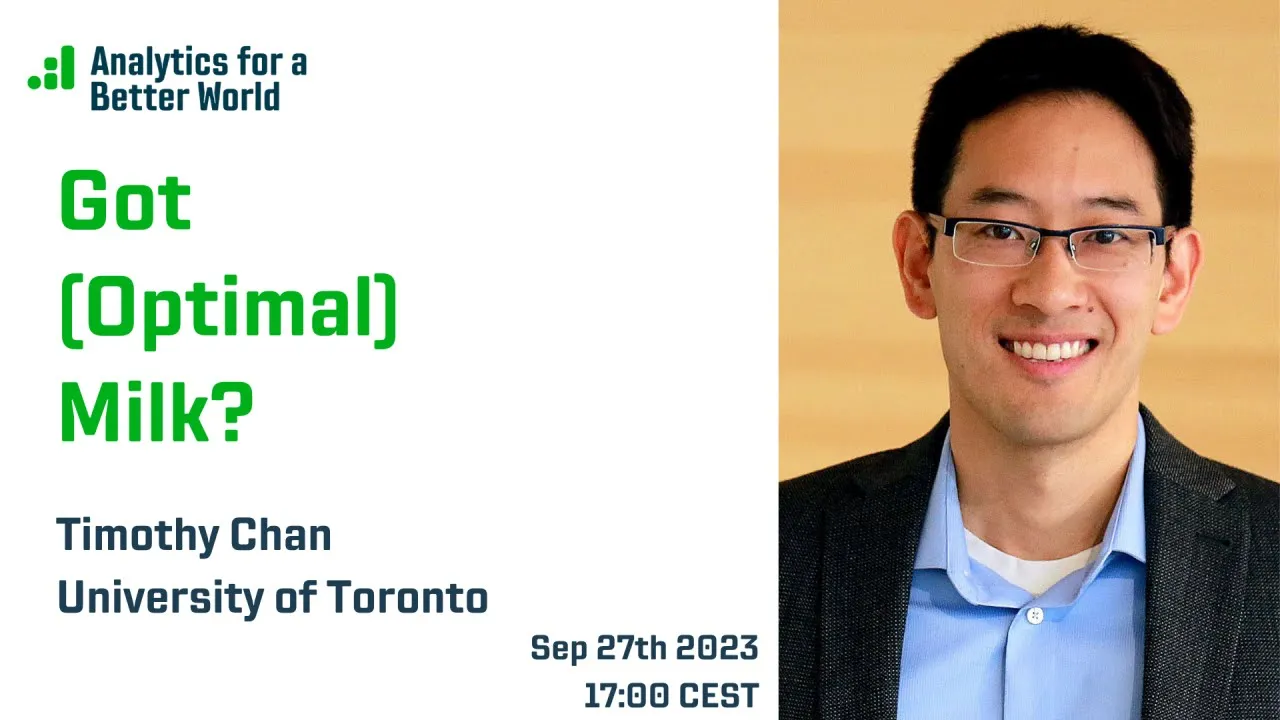
#14 Research meet-up: Optimised donor-milk pools met nutrition targets 31% more often
A machine-learning and optimisation approach for pooling donated human milk met clinical macronutrient targets approximately 31% more often than existing nurse-led practice during a year-long trial. It also reduced the time needed to create pooling recipes by 60%.

A machine-learning and optimisation approach for pooling donated human milk met clinical macronutrient targets approximately 31% more often than existing nurse-led practice during a year-long trial. It also reduced the time needed to create pooling recipes by 60%.
This meet-up is led by Timothy Chan, the Associate Vice-President and Vice-Provost, Strategic Initiatives at the University of Toronto, who is the Canada Research Chair in Novel Optimisation and Analytics in Health, and Professor in Mechanical and Industrial Engineering, as well as a Senior Fellow of Massey College.
His research focuses on operations research, optimisation and applied machine learning in areas including healthcare, medicine, sustainability and sports. He holds a BSc in Applied Mathematics from the University of British Columbia and a PhD in Operations Research from MIT. Before joining the University of Toronto, he worked at McKinsey & Company.
Why is donor-milk pooling difficult?
Human donor milk is an important source of nutrition for millions of infants born preterm each year.
Its macronutrients — primarily protein, fat and carbohydrates — are linked to infant growth and brain development, but their concentrations can vary substantially between individual donations. Milk banks therefore combine several donations into a single pool to produce milk with an appropriate nutritional profile.
Deciding which donations to combine creates a practical planning problem: many possible combinations exist, but the resulting pool needs to meet clinical nutrition targets.
How do prediction and optimisation work together?
The research team developed a framework combining machine learning and optimisation.
Machine learning first predicts the macronutrient content of individual milk deposits. Optimisation then determines how those deposits should be combined into pools to meet clinical targets.
The research team also collaborated with a partner milk bank to collect the data used to train the predictive models. Milk-bank operations were then simulated to refine the optimisation approach before it was tested in practice.
What changed during the year-long trial?
The team first observed the existing nurse-led pooling process and then introduced the data-driven approach. Pools created using the new method met clinical macronutrient targets approximately 31% more often than the baseline approach.
Creating the pooling recipes also took 60% less time.
The result therefore concerns both nutrition and operations: the method produced pools that more consistently matched the intended nutritional composition while reducing the planning time required from milk-bank staff.
More updates

News
The Hidden Millions in Humanitarian Logistics
Humanitarian organisations face a difficult equation: growing needs, shrinking budgets and millions of people who may not receive the assistance they require. Yet one of the largest opportunities to close this gap may be hiding in plain sight: the way humanitarian aid is procured, stored, transported and delivered.
Read more

Research Updates
New optimisation method makes huge-scale water-well planning solvable
A research project that began through the Analytics for a Better World Fellowship, responding to a Red Cross challenge in West Darfur, has been accepted for publication in OMEGA. The study develops a scalable way to identify where water wells could be placed so that as many people as possible live within 500 metres of one.
Read more

Research Updates
Ocean-plastic optimisation research wins INFORMS sustainability award
Research by Analytics for a Better World, the University of Amsterdam, London Business School and The Ocean Cleanup has received the INFORMS ENRE Best Publication Award in Environment and Sustainability.
Read more