Climate Action
·
International Journal of Hydrogen Energy
A new model cuts offshore hydrogen design testing from one minute to under a second
Assessing green hydrogen production via offshore wind in the Dutch North Sea: Complementing techno-economic simulation with machine learning and optimization
Publication Authors: Justin Starreveld, Laurens Frowijn, Riccardo Travaglini, Renske van ’t Veer, Alessandro Bianchini, Kenneth Bruninx, Dick den Hertog, Zofia Lukszo

Producing green hydrogen from offshore wind requires decisions about where to place wind farms, which technology to use and how large the system should be. Researchers from the University of Amsterdam, Delft University of Technology and the University of Florence combined simulation, machine learning and optimisation to compare these choices much faster, reducing calculations that took about a minute per design to under a second.
Summary
The faster models predicted hydrogen output and wind-farm efficiency within about 3% of the original simulation results, and cost outcomes within about 10%.
New offshore wind-to-hydrogen designs could be recalculated in under a second, making it much easier to compare different technical and environmental requirements.
Across the scenarios tested, estimated hydrogen production costs ranged from about EUR 4 to nearly EUR 30 per kilogram, showing how strongly design choices and assumptions affect the economics of green hydrogen.
Why is planning offshore wind-to-hydrogen systems so complex?
An offshore wind-to-hydrogen system uses electricity from wind turbines at sea to produce green hydrogen. The electricity powers an electrolyser, which splits water to make hydrogen.
Designing the system means deciding where the wind farm should be located, where hydrogen should be produced, which electrolyser technology to use and how large the different components should be. These choices affect both cost and environmental performance. offshore wind-to-hydrogen system involves linked choices: wind-farm size and location, electrolyser technology, whether hydrogen equipment is placed onshore or offshore, and environmental or spatial constraints.
Why is this a prescriptive analytics problem?
Simulation can show what happens under a chosen design. Prescriptive analytics asks a different question: which design best meets a specific objective and set of constraints?
That may mean finding the lowest-cost system, limiting an environmental by-product, or keeping infrastructure a minimum distance from shore. The challenge is searching across many possible designs without running the full simulation each time.
How did the team make the model faster?
Researchers from the University of Amsterdam, Delft University of Technology and the University of Florence combined techno-economic simulation, machine learning, and optimisation.
They first ran the detailed model about 4,000 times across different designs. Those results were used to train machine-learning models that approximate the original simulation much faster.
The trained models were then embedded in an optimisation solver. This allowed the system to search directly for a design that met a chosen objective and to recalculate when new requirements were added.
What did the findings show?
The faster models produced results close to the detailed simulations: estimates of hydrogen production and wind-farm efficiency differed by about 3%, while cost estimates differed by about 10%.
Once trained, the optimisation could return a detailed design in under a second and recalculate when constraints changed. Across the scenarios studied, estimated hydrogen production costs ranged from about EUR 4 to nearly EUR 30 per kilogram.
That range shows how strongly technology assumptions and design choices can affect the economics of offshore hydrogen. The study did not quantify downstream effects on energy prices, employment or communities. Its direct contribution was a faster way to make financial, spatial and environmental trade-offs visible before infrastructure decisions are fixed.
How can the findings inform other applications?
The approach could be applied to other planning problems where detailed simulations are too slow to evaluate many possible designs. By replacing repeated full simulations with a much faster model, decision-makers can compare more options and use optimisation to identify designs that best meet cost, technical or environmental goals.
Potential applications include other energy-system design problems where planners need to compare cost, environmental constraints and technology choices. Future work can test the approach with updated technology costs, additional environmental indicators and other offshore energy configurations.
More publications
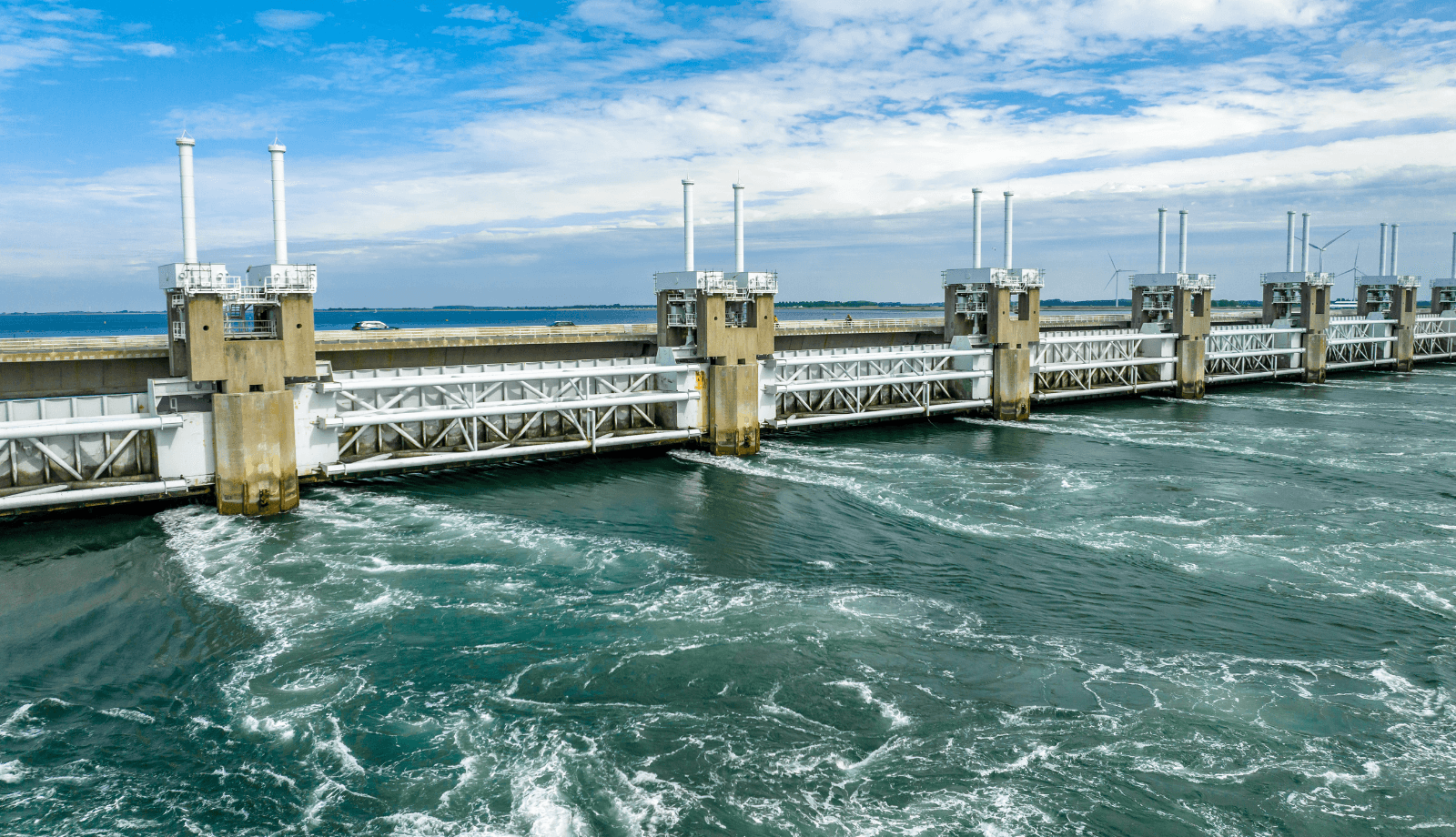
Focusing flood protection on three regions cut projected costs by €7.8 billion ›
A 2008 proposal to raise Dutch flood-protection standards tenfold nationwide was estimated to cost EUR 11.5 billion. A collaboration across research institutes, government and engineering organisations used optimisation and cost-benefit analysis to identify where stronger standards produced the greatest protection per euro. ›
One model links vaccine demand and routes across 3 Kenyan counties ›
Food prices can change sharply during conflict, poor harvests and wider market shocks. Researchers from the University of Amsterdam and Tilburg University examined how the World Food Programme's supply planning can account for this uncertainty, using real price data and supply routes from a food-assistance operation in Syria. ›
