Climate Action
·
Omega
Focusing flood protection on three regions cut projected costs by €7.8 billion
Adjustable robust strategies for flood protection
Publication Authors: Krzysztof Postek, Dick den Hertog, Jarl Kind, Chris Pustjens
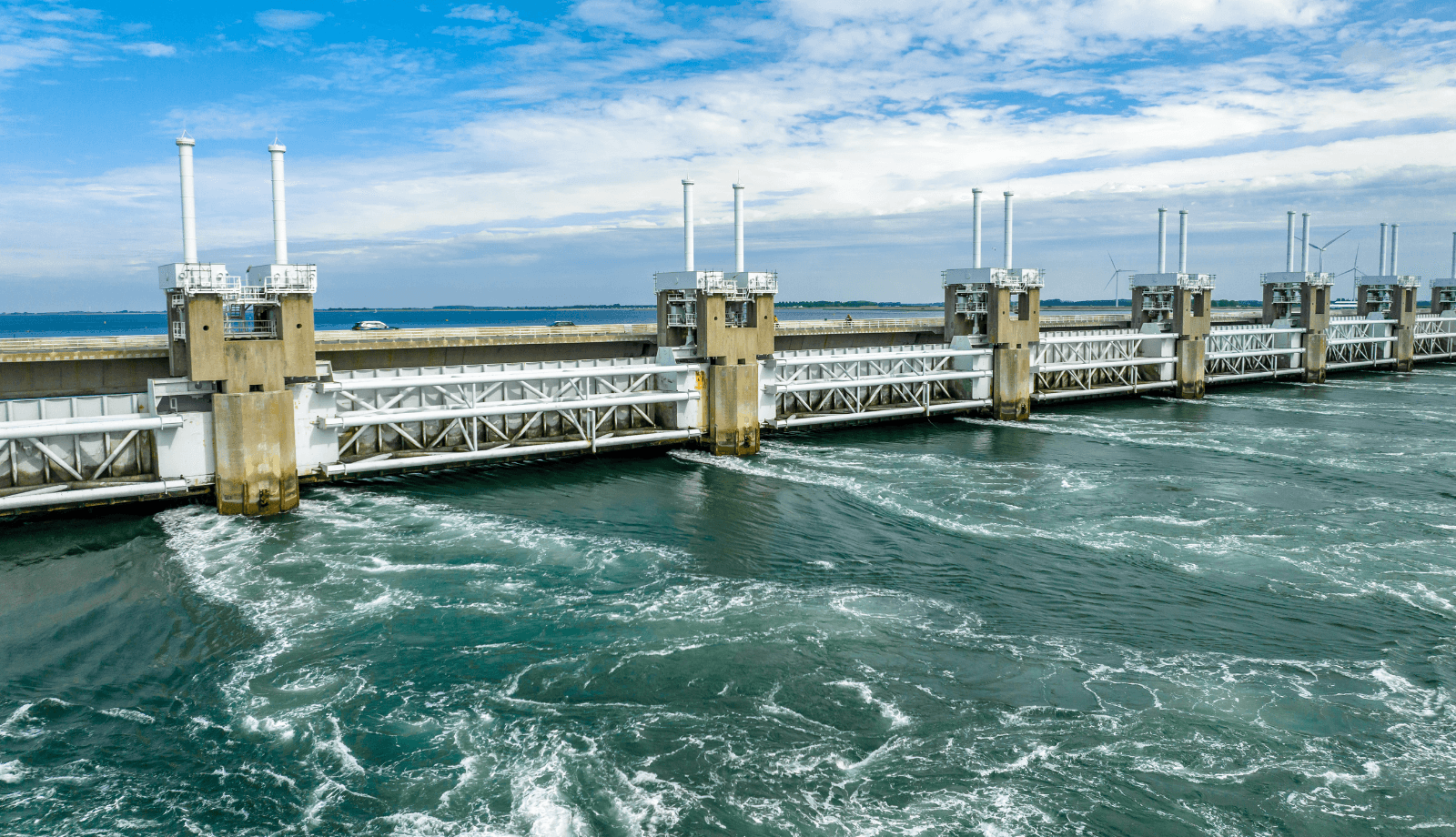
A 2008 proposal to raise Dutch flood-protection standards tenfold nationwide was estimated to cost EUR 11.5 billion. A collaboration across research institutes, government and engineering organisations used optimisation and cost-benefit analysis to identify where stronger standards produced the greatest protection per euro.
Summary
A nationwide tenfold increase was estimated to cost EUR 11.5 billion.
Concentrating stronger standards in three regions captured about two-thirds of the original plan's protective benefit while reducing projected costs by about EUR 7.8 billion.
The findings were adopted in 2012 as a basis for new Dutch flood-protection legislation.
Why can one national flood standard lead to poor investment choices?
Flood risk is not distributed evenly. Regions differ in expected flood probability, population, economic activity and the consequences of a failure.
Applying the same increased protection everywhere can therefore direct large amounts of public funding to places where the additional protection produces relatively little benefit, while other areas face higher risk.
Why is this a prescriptive analytics problem?
The decision is how limited public investment should be allocated across regions. The objective is not simply to estimate flood risk, but to determine where stronger protection produces the greatest reduction in expected damage and risk for the available budget.
Optimisation methods can compare many combinations of regional standards at the same time and identify an investment pattern that balances protection and cost.
How did the team evaluate the national proposal?
The project involved the CPB Netherlands Bureau for Economic Policy Analysis, Deltares, Tilburg University, HKV Consultants, Delft University of Technology, the Ministry of Infrastructure and the Environment and the Delta Commissioner's office.
The team combined cost-benefit analysis with mixed-integer nonlinear optimisation. The model evaluated regional protection levels against the cost of stronger defences and the expected consequences of flooding.
The team also used Monte Carlo simulation to test the recommendations across many possible future outcomes rather than relying on one set of assumptions.
What did the findings show?
The analysis found that increasing standards tenfold everywhere was not the most cost-effective allocation. A stronger increase concentrated in three regions captured roughly two-thirds of the protective benefit of the original nationwide proposal while reducing projected costs by about EUR 7.8 billion.
The Dutch government adopted the findings in 2012 as a basis for new flood-protection legislation.
For communities in higher-risk areas, the result meant stronger standards could be implemented in locations where the expected consequences of flooding were greatest. At the same time, lower total spending reduced the amount of public funding tied to a blanket national increase.
How can the findings inform other applications?
The same decision structure could be applied where flood risk varies substantially between regions and investment budgets are limited, as long as the specific standards reflected local flood probabilities, infrastructure costs, population, and economic conditions.
More broadly, this study highlights how cost-benefit analysis and optimisation can be combined when public authorities need to prioritise long-term infrastructure investments rather than apply one rule everywhere.
More publications

Blood banks could cut transport costs by 10% without slowing hospital deliveries ›
Hospitals need blood products to arrive quickly, especially in emergencies, but keeping too many distribution centres open can be costly. Sanquin, the Finnish Red Cross Blood Service and Amsterdam Business School developed a model to test where blood distribution centres should be located. In both the Netherlands and Finland, the model identified options that cut transport costs by about 10% while maintaining the same delivery performance. ›
A new model cuts offshore hydrogen design testing from one minute to under a second ›
Food prices can change sharply during conflict, poor harvests and wider market shocks. Researchers from the University of Amsterdam and Tilburg University examined how the World Food Programme's supply planning can account for this uncertainty, using real price data and supply routes from a food-assistance operation in Syria. ›
