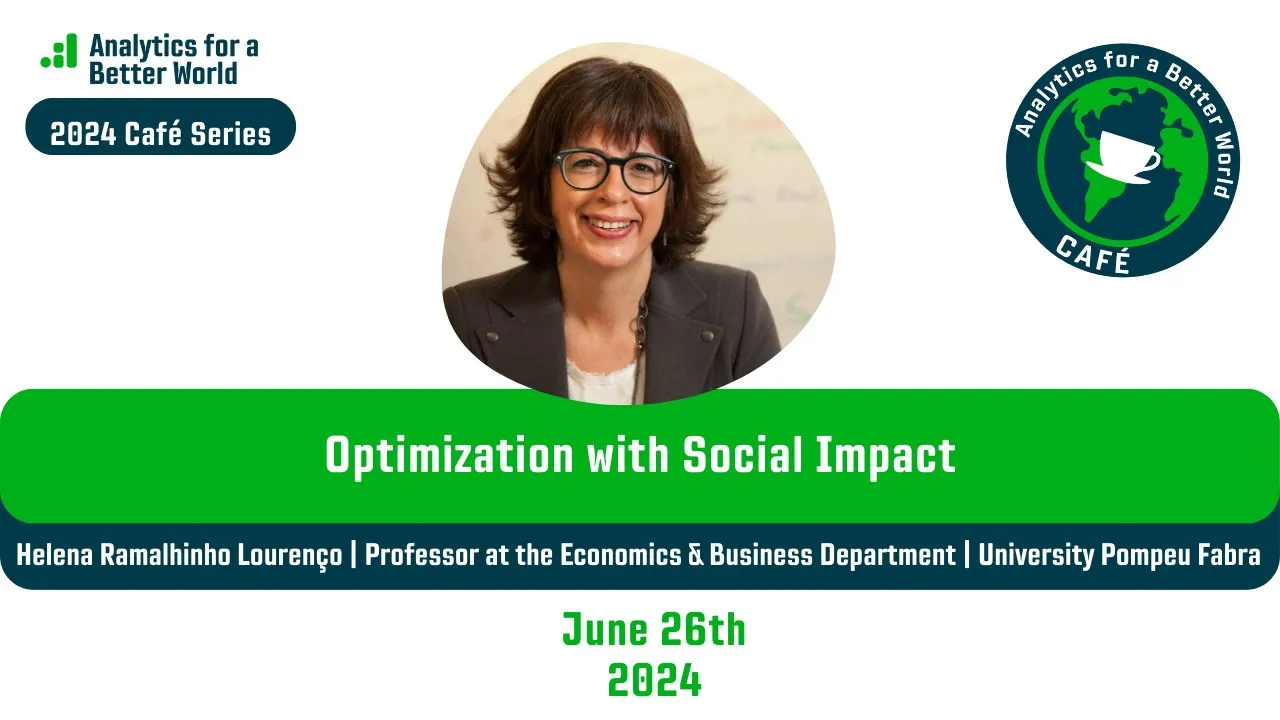

The Talk
Analytics focuses on transforming data into insights by applying advanced analytical methods, based on mathematics, statistics, operations research and artificial intelligence models and algorithms, to improve the performance of an organisation. One of the main tools in Analytics is Optimization. In this talk, Helena discusses the optimisation tools and methodologies applied to Non-Profit Organisations (NPO). She describes applications of Mathematical Programming Models and Metaheuristics Algorithms to Social and Healthcare organisations. Some examples of applications of Optimization in these organisations are: home social and health care logistics and scheduling; optimisation of assistive technology services; planning sustainable transportation, and mobility optimisation for social care services. She also focuses on the main aspects of these models and algorithms, as well as the main differences from other more frequent applications, such as in manufacturing and retailing industries.
About Helena Ramalhinho Lourenço
Helena Ramalhinho Lourenço is a Full Professor at the Economics and Business Department at the University Pompeu Fabra, Barcelona, Spain. She has a B.A. and a Master's degree in Statistics and Operations Research from the University of Lisbon, Portugal, and a PhD in Operations Research from Cornell University, New York, USA. She has been involved in different research projects and consulting for business firms in the area of Operations Research and Logistics. She is currently the director of the Business Analytics Research Group. Her research interests include Operations Research, Scheduling, Combinatorial Optimisation, Metaheuristics, Iterated Local Search, Heuristic Search Optimisation, Vehicle Routing, and applications in Supply Chain Management, Logistics, Operations Management and Health Care. Actually, Helena is the vice-rector (president) for Internationalisation at the UPF.
More updates

News
The Hidden Millions in Humanitarian Logistics
Humanitarian organisations face a difficult equation: growing needs, shrinking budgets and millions of people who may not receive the assistance they require. Yet one of the largest opportunities to close this gap may be hiding in plain sight: the way humanitarian aid is procured, stored, transported and delivered.
Read more

Research Updates
New optimisation method makes huge-scale water-well planning solvable
A research project that began through the Analytics for a Better World Fellowship, responding to a Red Cross challenge in West Darfur, has been accepted for publication in OMEGA. The study develops a scalable way to identify where water wells could be placed so that as many people as possible live within 500 metres of one.
Read more

Research Updates
Ocean-plastic optimisation research wins INFORMS sustainability award
Research by Analytics for a Better World, the University of Amsterdam, London Business School and The Ocean Cleanup has received the INFORMS ENRE Best Publication Award in Environment and Sustainability.
Read more