News
ABW Café Series
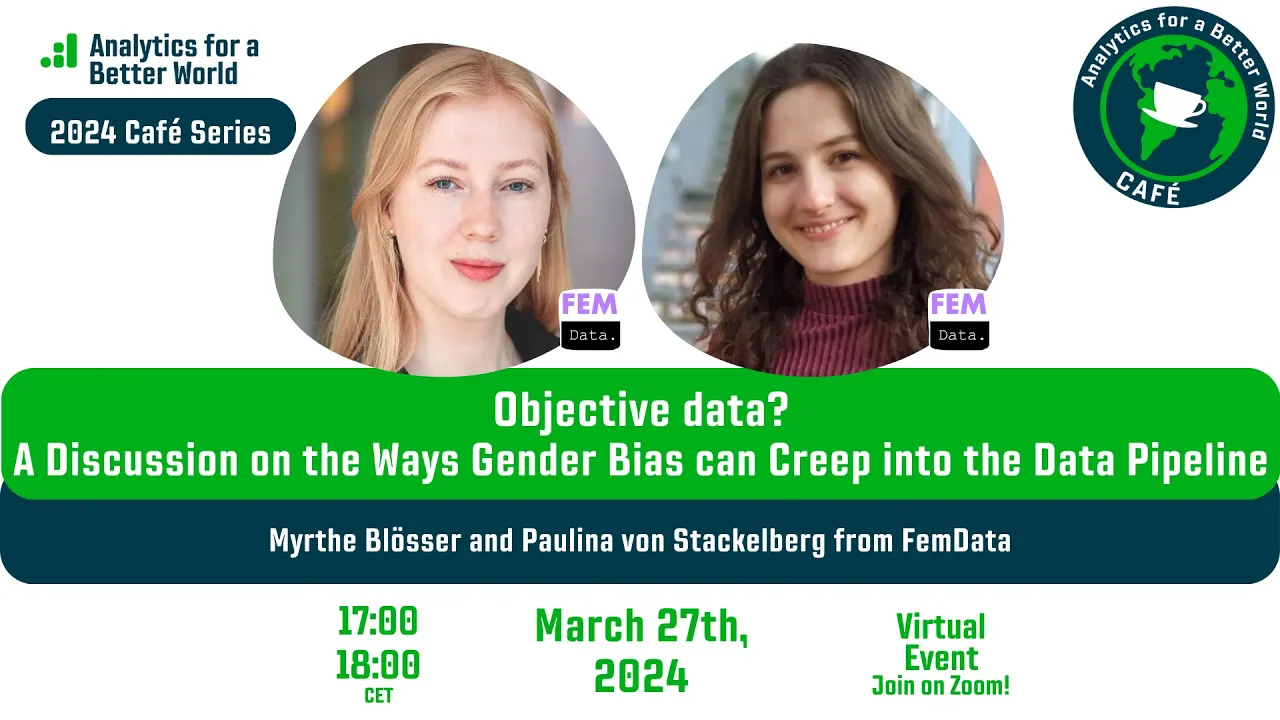
Objective data? A discussion on the ways gender bias can creep into the data pipeline

In honour of International Women’s Day happening this month, in this edition of the ABW Café, we learned more about the presence of gender bias in the data pipeline.
The Talk
Data are used everywhere: Ranging from Healthcare to Marketing and Finance, the way we analyze information holds considerable influence in society. In many fields, data analytics has the potential to either sustain prevailing societal inequalities or transform them – however, data are often riddled with biases. To stimulate discussion around this topic and connect stakeholders, Myrthe Blösser and Paulina von Stackelberg started FemData in August 2023. With FemData, they specifically focus on the ways that gender biases can distort model outcomes by influencing the collection, labelling, and interpretation of data, leading to skewed insights and perpetuating inequality. In this talk, Myrthe and Paulina introduced their initiative and provided some examples from previous research on the topic of gender bias in data applications.
About The Speakers
Myrthe Blösser is a PhD candidate in consumer psychology with the Marketing group of Amsterdam Business School. In her research, she examines different tools to help citizens with low AI literacy protect themselves against unfair and discriminatory AI.
Paulina von Stackelberg is a PhD candidate in Business Analytics at the University of Amsterdam. Her research revolves around prediction models for time-dependent data in healthcare and renewable energy. Furthermore, she is interested in the social context surrounding data applications.
More updates

News
The Hidden Millions in Humanitarian Logistics
Humanitarian organisations face a difficult equation: growing needs, shrinking budgets and millions of people who may not receive the assistance they require. Yet one of the largest opportunities to close this gap may be hiding in plain sight: the way humanitarian aid is procured, stored, transported and delivered.
Read more

Research Updates
New optimisation method makes huge-scale water-well planning solvable
A research project that began through the Analytics for a Better World Fellowship, responding to a Red Cross challenge in West Darfur, has been accepted for publication in OMEGA. The study develops a scalable way to identify where water wells could be placed so that as many people as possible live within 500 metres of one.
Read more

Research Updates
Ocean-plastic optimisation research wins INFORMS sustainability award
Research by Analytics for a Better World, the University of Amsterdam, London Business School and The Ocean Cleanup has received the INFORMS ENRE Best Publication Award in Environment and Sustainability.
Read more