Research
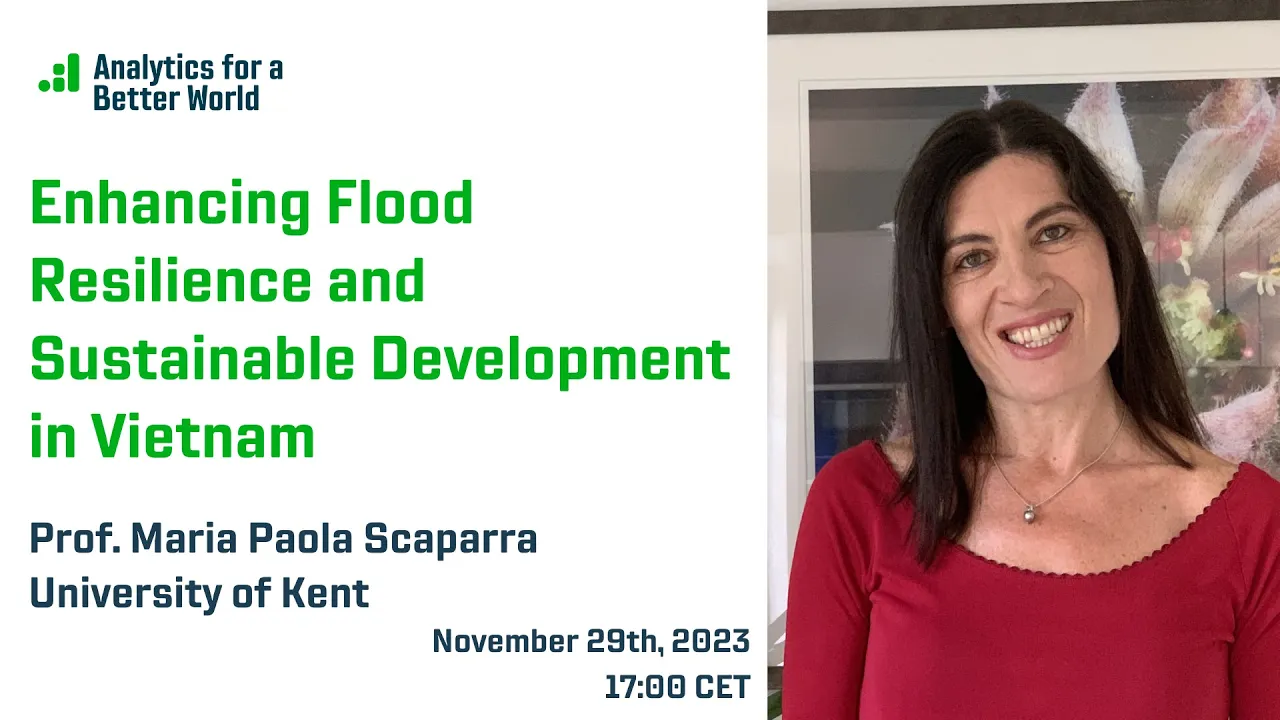
#15 Research meet-up: 15 – 20% of planned flood investment could halve modelled damage and congestion in Hanoi
The GCRF-OSIRIS project combines flood modelling and optimisation to identify when long-term flood-protection investments should be made in Vietnamese cities. In its application to Hanoi, the model found that spending 20% of the total cost of the projects considered could reduce both road-infrastructure damage and congestion by half.

The GCRF-OSIRIS project combines flood modelling and optimisation to identify when long-term flood-protection investments should be made in Vietnamese cities. In its application to Hanoi, the model found that spending 20% of the total cost of the projects considered could reduce both road-infrastructure damage and congestion by half.
This meet-up was led by Prof. Maria Paola Scaparra, Professor of Management Science at Kent Business School, University of Kent. She has held roles including Associate Dean of Research and Innovation, Head of the Management Science Group and Programme Director for the MSc Business Analytics.
She holds an MS in Management Science and Engineering from Stanford University and a PhD in Mathematics Applied to Economic Decisions from the University of Pisa. Her work includes international and multidisciplinary projects funded by organisations including the British Academy, the Engineering and Physical Sciences Research Council and Innovate UK, and she is a member of the General Council of the UK Operational Research Society.
Why does Hanoi need long-term flood planning?
Vietnam has one of the world's highest levels of exposure to flooding. Cities experience severe floods that can damage homes and public infrastructure, disrupt businesses and livelihoods, contaminate water and increase exposure to water-related disease.
In Hanoi, flood risk is compounded by climate change, rapid urbanisation and an ageing drainage system.
Choosing how to respond involves more than identifying possible flood-protection projects. Decision-makers also need to determine which investments should be prioritised and when they should be implemented when budgets are limited.
Why is this a prescriptive analytics problem?
The GCRF-OSIRIS project examines how cost-efficient, long-term investments in structural flood protection can reduce the social and economic consequences of flooding.
The study combines methods from hydrology, meteorology and transport economics. Hydrology examines how water moves through the environment, while transport economics considers effects such as disruption and congestion.
These inputs feed into an optimisation model that determines the schedule of flood-mitigation projects under different flood scenarios, with the objective of reducing road-infrastructure damage and congestion.
How was the approach developed?
The research was conducted with Vietnamese stakeholders in government and academia and with the involvement of local communities.
This matters because choices about flood protection affect transport, public infrastructure, livelihoods and neighbourhoods differently. Bringing these perspectives into the project connects the optimisation model with the local conditions in which investments would ultimately be considered.
What did the Hanoi analysis show?
For the projects examined in Hanoi, the model found that using 20% of the overall project costs could be sufficient to reduce both road damage and congestion rates by 50%.
This is a modelled investment result, not evidence that the spending has already been made or that flood impacts in Hanoi have already fallen by half.
The finding instead shows how optimisation can identify which investments may provide a large share of the available benefit without requiring every proposed project to be implemented at once.
What came out of the wider collaboration?
The project also contributed to partnerships between researchers and practitioners in Southeast Asia and led to the establishment of the Southeast Asia Operations Research Network (SEAORN). The network provided a platform for further operations research collaboration between academics and practitioners across the region.
More updates

News
The Hidden Millions in Humanitarian Logistics
Humanitarian organisations face a difficult equation: growing needs, shrinking budgets and millions of people who may not receive the assistance they require. Yet one of the largest opportunities to close this gap may be hiding in plain sight: the way humanitarian aid is procured, stored, transported and delivered.
Read more

Research Updates
New optimisation method makes huge-scale water-well planning solvable
A research project that began through the Analytics for a Better World Fellowship, responding to a Red Cross challenge in West Darfur, has been accepted for publication in OMEGA. The study develops a scalable way to identify where water wells could be placed so that as many people as possible live within 500 metres of one.
Read more

Research Updates
Ocean-plastic optimisation research wins INFORMS sustainability award
Research by Analytics for a Better World, the University of Amsterdam, London Business School and The Ocean Cleanup has received the INFORMS ENRE Best Publication Award in Environment and Sustainability.
Read more