The World Bank and Analytics for a Better World combined fragmented data on health facilities, population and roads to examine where additional healthcare facilities could improve physical access in Timor-Leste. The analysis found that strategically locating seven additional facilities could increase modelled accessibility from 70% to 80%, potentially bringing 136,000 more people within reach of care.
Why is healthcare access difficult to plan when the data is fragmented?
Knowing that a country needs more healthcare capacity does not tell planners where a new facility should be located.
That decision depends on several pieces of information: where people live, where existing health facilities are located, which roads connect communities to those facilities and how far people need to travel. In Timor-Leste, those datasets did not exist in one complete source. The World Bank team had to bring together and cross-check several separate datasets before they could analyse access consistently.
This creates an equity issue in data-driven decision-making. Organisations operating with extensive and well-connected datasets can use analytics routinely to make location decisions. Where information is incomplete or stored across different systems, even establishing the current level of access can require substantial work before optimisation can begin.
Why is this a prescriptive analytics problem?
The first question is descriptive: which communities currently have reasonable physical access to healthcare?
The next question is prescriptive: if new facilities can be added, where should they be placed so that more people can reach healthcare?
That distinction matters. Mapping existing facilities can show where access is limited, but it does not identify which investment would improve access most.
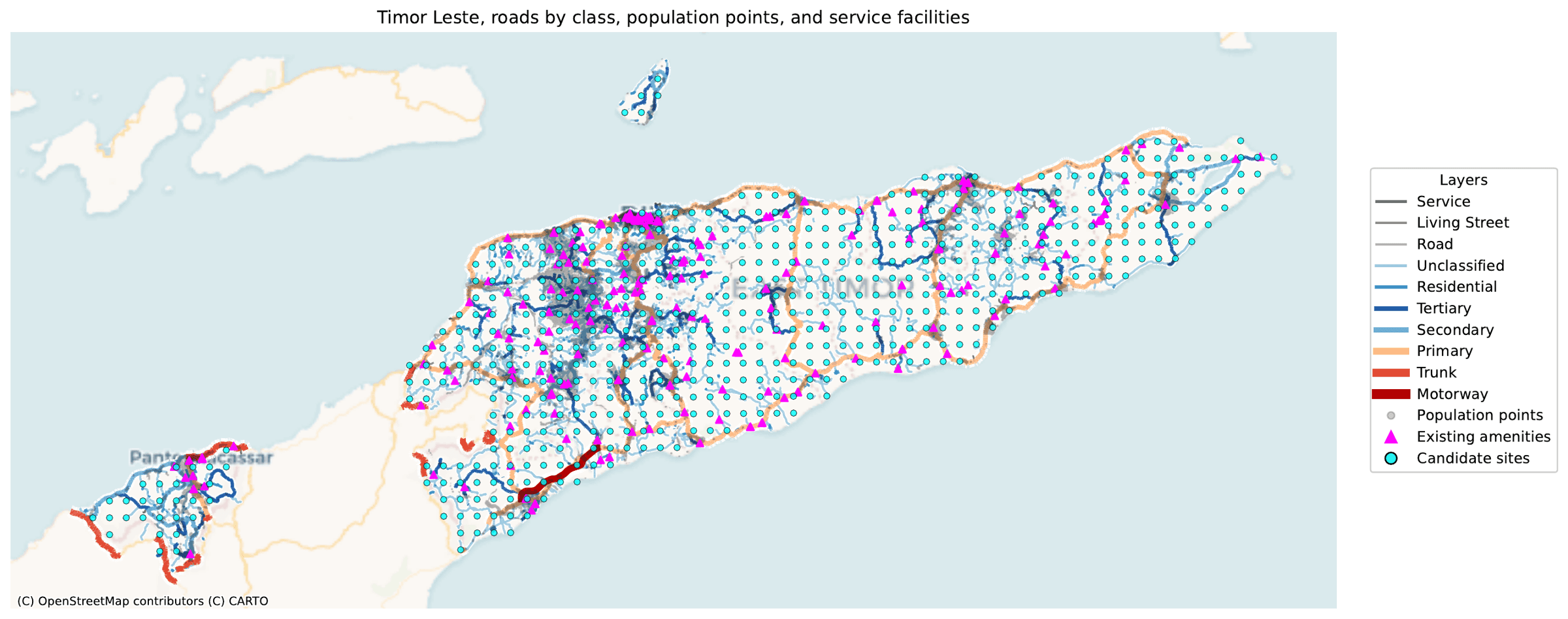
The analytics therefore combine information on population, existing facilities and the road network and compare possible locations for new infrastructure. The objective is to identify locations that increase the number of people within reach of healthcare rather than choosing sites individually or on distance alone.
How did the World Bank and Analytics for a Better World approach the problem?
The collaboration brought together World Bank knowledge of public-sector planning with Analytics for a Better World's expertise in optimisation and geospatial analytics.
The project involved World Bank colleagues Kai Kaiser and Parvathy Krishnan and ABW researchers including Dick den Hertog, Joaquim Gromicho and Britt van Veggel. The work contributed to an open-source toolkit now known as PISA (Public Infrastructure Service Access).
PISA is designed for questions about where essential infrastructure should be located. Rather than assuming that complete datasets are available, the tool can combine the information that exists and use it to compare possible locations.
In Timor-Leste, the analysis brought together information about population distribution, existing healthcare facilities and road connections. It was used to examine where additional primary healthcare facilities could improve physical access and inform planning by the country's Ministry of Health.
What is the potential impact?
Seven strategically placed additional facilities could increase modelled healthcare accessibility from 70% to 80% in Timor-Leste.
That increase corresponds to around 136,000 people potentially gaining better physical access to healthcare under the modelled scenario.
The result is important because it changes the planning question from simply "how many facilities should be added?" to "where can each additional facility reach the most people who currently have limited access?"
These results can now inform the World Bank and public-sector decision-makers with evidence for comparing infrastructure investments before resources are committed.
Why does making the tool usable matter?
Bringing the data together is only part of the challenge. The analysis also needs to be understandable and usable by the people making infrastructure decisions.
The World Bank team stressed that sophisticated analytics have less value if using them requires specialist technical knowledge each time a question changes. Public-sector tools therefore need to make results accessible without requiring decision-makers to understand the mathematics behind the model.
PISA was developed as an open-source tool so that the approach can be adapted rather than rebuilt for every new setting. This also makes it possible to extend the analysis as better local data becomes available.
What can this mean for future infrastructure planning?
The same decision appears well beyond primary healthcare: where to locate stroke centres, testing facilities, mobile health services, schools or other public infrastructure when resources are limited, and communities are distributed unevenly.
PISA has since been applied to healthcare-access questions in countries including Vietnam, Nepal and Armenia, as well as other infrastructure-access problems. ABW is also developing the toolkit to account for factors such as floods and other disruptions that can change whether a road — and therefore a healthcare facility — is actually reachable.
The wider lesson from Timor-Leste is that incomplete data does not have to prevent analytical planning. By bringing fragmented information together and connecting it to an explicit decision, planners can move from identifying where access is limited to comparing where the next investment could make the largest difference.