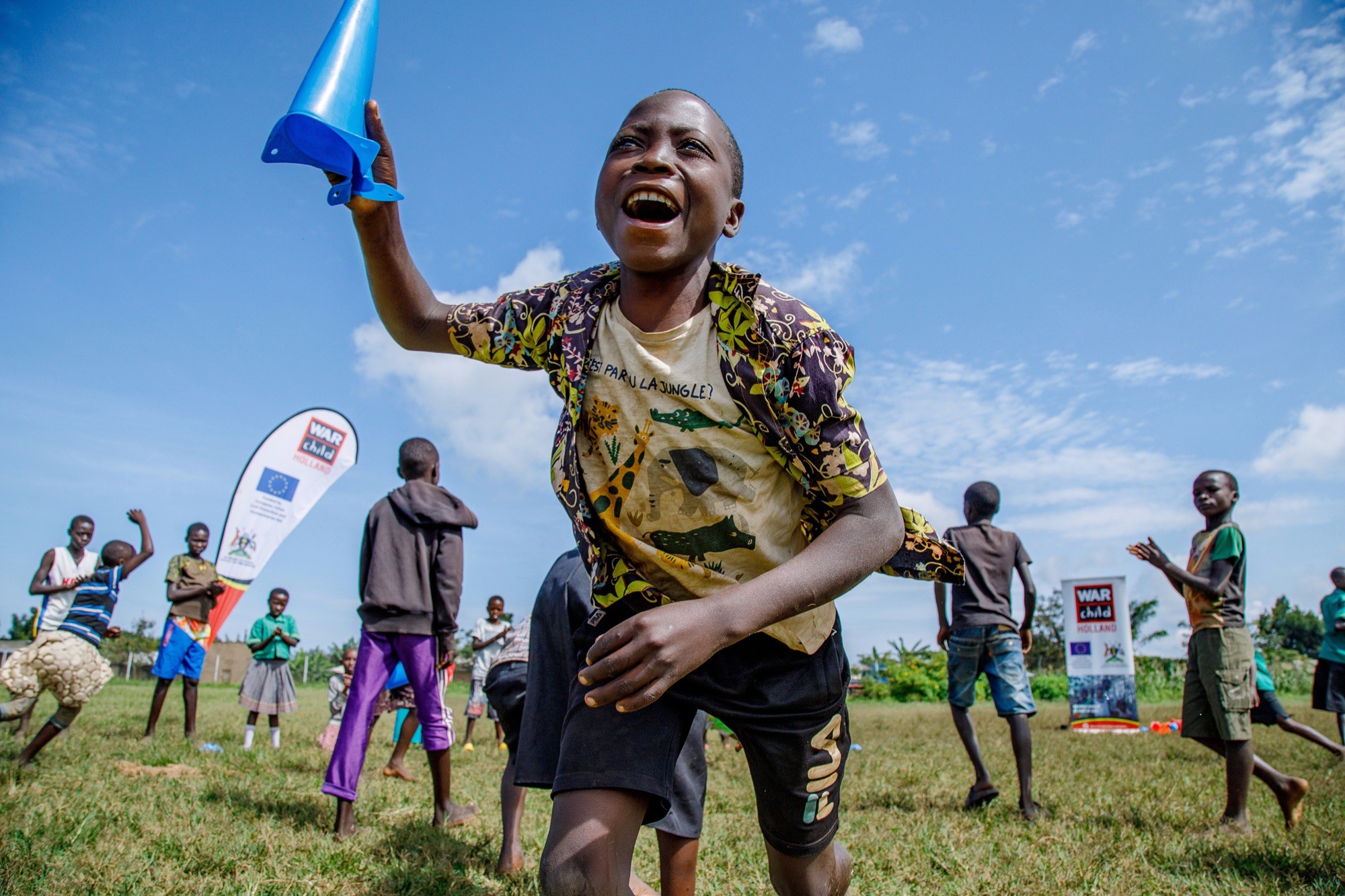

War Child has spent more than a decade developing evidence-based approaches for children and caregivers affected by conflict. Together with Analytics for a Better World, ORTEC and Pipple, it is developing a Quality of Care data system to track whether those approaches continue to be delivered as intended as they reach more people.
Why does programme quality become harder to track as services scale?
War Child develops evidence-based methodologies for the wellbeing, mental health, education and protection of children affected by conflict and their caregivers. These approaches are tested using research methods such as randomised controlled trials and evaluated through outcomes including changes in wellbeing and stress.
As programmes expand through partnerships, however, repeating the same level of research assessment in every setting is difficult. War Child needed a way to understand whether programmes were continuing to be delivered as intended without relying on intensive evaluations for every implementation.
That led to its Quality of Care framework, which uses three indicators: attendance, whether participants take part as intended; competency, whether facilitators have the skills needed to deliver the programme; and fidelity, whether the programme is delivered in line with the tested approach.
These indicators do not replace measurements of outcomes for children and caregivers. They provide more regular signals about programme delivery as approaches scale.
Why does more timely quality data matter for decisions?
Collecting quality data is useful only if War Child and its partners can act on it.
If attendance falls, teams may need to understand what is limiting participation. If fidelity changes, they may need to examine training, programme delivery or adaptations made for a particular context. More timely information can make these questions visible while programmes are still running.
The project therefore focuses on turning data into information that can support practical decisions. It is not a prescriptive analytics system that automatically recommends what teams should do. Instead, it creates the data foundation needed to identify where attention, learning or adaptation may be required.
War Child identified three priorities: defining and prioritising Quality of Care use cases, developing the most urgent ones and strengthening data literacy across the organisation.
How did War Child, ABW, ORTEC and Pipple develop the approach?
War Child collaborated with Analytics for a Better World, ORTEC and Pipple to translate the Quality of Care framework into practical data use cases and technical requirements.
War Child brought its knowledge of programme delivery, partners and humanitarian contexts. Analytics for a Better World contributed experience in developing analytics around mission-driven challenges and bridged the organisation with technical expertise from ORTEC and Pipple.
ORTEC contributed to an executive data-strategy report and a proof-of-concept data pipeline — the process that moves collected information into a form where it can be organised, checked and analysed.
Rather than beginning by building a large system, the collaboration first asked what information teams needed, which gaps prevented them from using it and which decisions the data should eventually inform.
This also allowed colleagues and partners to shape the use cases around the realities of programme delivery rather than adapting their work to a predefined technical solution.

What did the first pilots show?
One early assumption was that collecting additional Quality of Care data might create an unwanted burden for partners.
The pilots challenged that assumption. Partners saw value in having access to quality information closer to the time programmes were being delivered, particularly where it could inform programme decisions, fundraising and advocacy.
This changed the focus of the project. The question was no longer simply how War Child could collect more quality data, but how War Child and its partners could use that information in ways that were useful to them.
The work also generated interest from funders. The LEGO Foundation invested in the further development of the Quality of Care data system, allowing War Child to continue designing it around partners' needs and practical constraints such as data collection, information sharing and digital connectivity.
What changed in War Child's approach to data?
The collaboration reinforced the importance of defining the decision before developing the technical solution.
Starting with smaller use cases allowed War Child to test what teams and partners actually needed before building a larger system. It also showed that data is relevant beyond monitoring, evaluation and ICT teams: programme staff, partners, fundraisers and leadership may all use the same information for different purposes.
"All the input you need to understand your data challenges and opportunities is already in your organisation. Start by having conversations with your teams on the pain points they have in relation to data. What data do they need? What are the gaps?
These conversations will reveal the outlines of relevant use cases. By letting your teams lead the way, you will get buy-in and commitment for the development of relevant use cases, processes and tools. A good partner can provide additional expertise to guide these conversations and shed light on possible technical solutions.
It is crucial to also have the support of senior management and the board. They need to understand why they need to invest time and money in a data solution. Make a clear case for the return on investment which reflects their own concerns or ambitions around efficiency, impact and income. Data analytics are no longer unique to the realm of the MEAL and ICT teams. The whole organisation – and partners – can benefit in different ways from the experience, the learnings and of course, the results."
Laura Miller, War Child Alliance Director, Programme Quality, Scaling & Advocacy
The project therefore became as much about building a way of working with data as building the technology itself.
What can this mean as War Child's programmes continue to scale?
The Quality of Care data system is still being developed, so the project has not yet demonstrated a quantified improvement in outcomes for children or caregivers.
Its current contribution is a stronger infrastructure for learning about programme quality as approaches expand through partnerships. More timely information on attendance, competency and fidelity can give War Child and its partners a clearer picture of how programmes are being delivered and where further attention may be needed.
The next step is to continue developing the system with partners, test how quality information is used across different contexts and account for practical constraints such as connectivity and data collection.
The longer-term aim remains the same: to expand evidence-based programmes while maintaining visibility over the quality of care children and caregivers receive.
Acknowledgement: With thanks to Ruud Mullers, CTO and Data Scientist at Pipple, alongside the teams at War Child, ORTEC and Analytics for a Better World.