
Why is finding ocean plastic a routing problem?
The Ocean Cleanup aims to remove 90% of floating ocean plastic by 2040. Reaching that target depends on the collection system itself, but also on where vessels spend their time at sea.
Plastic does not remain in one place. Ocean currents move it continuously, while wind, waves and changing weather affect both where it gathers and how vessels can operate. Cleanup trips can last for weeks, so choosing a route towards denser patches can increase collection without increasing the time spent offshore.
This makes the challenge a prescriptive analytics problem: the question is not only where plastic is likely to be, but which route a vessel should take next when plastic movement, weather and operational limits all change over time.
Turning years of ocean data into route decisions
The Ocean Cleanup had already built a detailed evidence base on the Great Pacific Garbage Patch. Its 2015 Mega Expedition mapped 3.5 million square kilometres of the North Pacific, followed by an aerial survey in 2016. The next step was to turn that information into day-to-day routing decisions.
Together, The Ocean Cleanup, Analytics for a Better World and researchers from London Business School developed a model that combines forecasts of plastic density with sailing conditions and operational constraints. For System 002, known as Jenny, the model can look up to seven days ahead, estimate how plastic concentrations may shift and identify routes towards denser areas while accounting for turns and sailing conditions.
“These boats are at sea for weeks, constantly on the lookout for high-density plastic locations. Our algorithms plot the best possible routes: where there’s plenty of plastic and favourable sailing conditions.”
Professor Dick den Hertog, Science to Impact Director, Analytics for a Better World

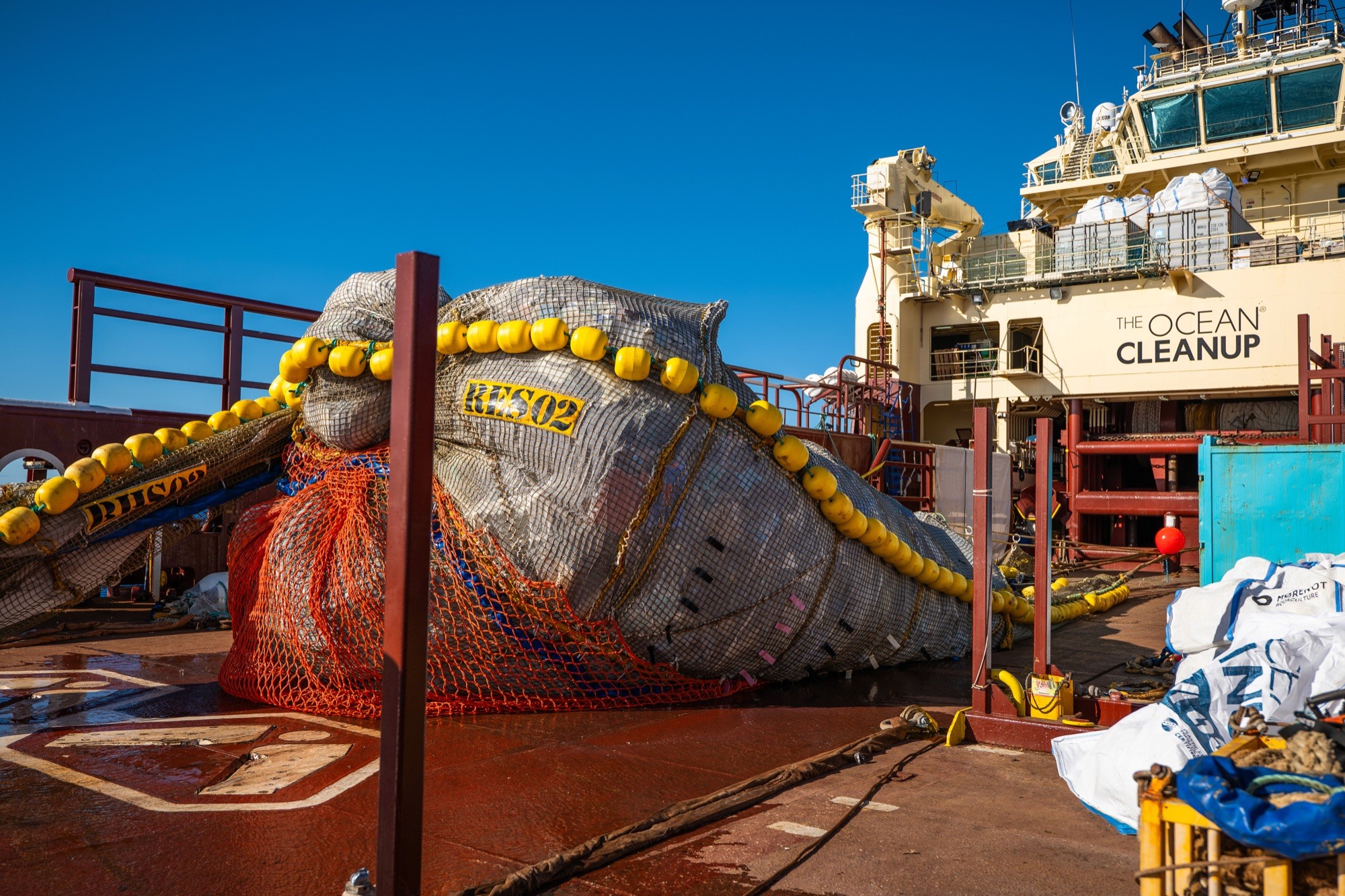
Aerial Shot of Catchment System from the Ocean Cleanup Gallery
What changed when routing decisions used the model?
Tested against one year of ocean and weather data, the optimisation-based routing increased modelled plastic collection by 60% compared with The Ocean Cleanup’s previous routing strategy. In some winter simulations, the improvement reached 90%, when rough seas made the timing of collection and emptying decisions especially important.
The Ocean Cleanup also reported that the strategy increased the plastic density encountered by its vessels by about 1.5 times. In practical terms, vessels can spend more of their time in areas where there is more plastic to collect.
While the team has not currently quantified a reduction in fuel use, emissions or bycatch, they showed that better routing can increase the amount of plastic collected with the same time at sea. This can in turn reduce the vessel activity needed per kilogram collected and improve the use of existing operational resources.
“We intend to remove plastics at minimal cost - financially, but also in terms of emissions and fish bycatch.”
Arjen Tjallema, Head of Technology, The Ocean Cleanup
Planning beyond a single cleanup vessel
Routing is one part of a larger operational question. As The Ocean Cleanup expands its fleet, different vessels may tow collection systems, carry out inspections and repairs, or move collected plastic.
The Ocean Cleanup and Analytics for a Better World therefore also developed an integrated operations model to compare different fleet configurations and their financial and environmental consequences. The aim is to understand which combination of vessels and tasks can increase collection while keeping costs and other environmental effects under control.
What can this mean as operations scale?
The routing work shows how data gathered to understand ocean plastic can also be used to decide where vessels should sail each day. The fleet model extends that logic to longer-term decisions about how operations could grow.
Future applications could test whether the same collection gains hold with new cleanup systems, changing weather patterns and different fleet configurations. The value of the approach is that these choices can be compared before additional vessels or equipment are committed.
Acknowledgement: This project was only possible because of the amazing work done by Baizhi Song and Jean Pauphilet of London Business School, and Marijke Lijzenga, Guusje Scheijen, Jelke van Hoorn and Iris van Beuzekom from ORTEC.